An evolving design language

Pixelgrade Pattern Language

A living language for making coherent, original sites across scales. Use it to read a composition, compare recurring solutions, and assemble a working language for the next site.

Move from whole pages to decisive details.

The map keeps every public stage visible. Solid entries are canonical; the others show where the language is still learning, merging, or changing its mind.

One catalogue, one pattern in focus.

16 patterns in view

What do the stages mean?
Canonical
Reviewed, recurrent, and validated through original composition.
Emerging
The invariant is visible, but a contradiction or composition test remains.
Field Note
A contextual observation whose broader claim is still deliberately small.
Merged, Retired, Contradicted
Useful history remains visible when the language changes its mind.

CandidateSectionField Note

Enquiry Directory with Disclosure

A contact page serves several visitor intentions. One generic address gives little help choosing a route; an undifferentiated long directory makes every visitor scan everything.

Different expressions, the same pattern underneath.

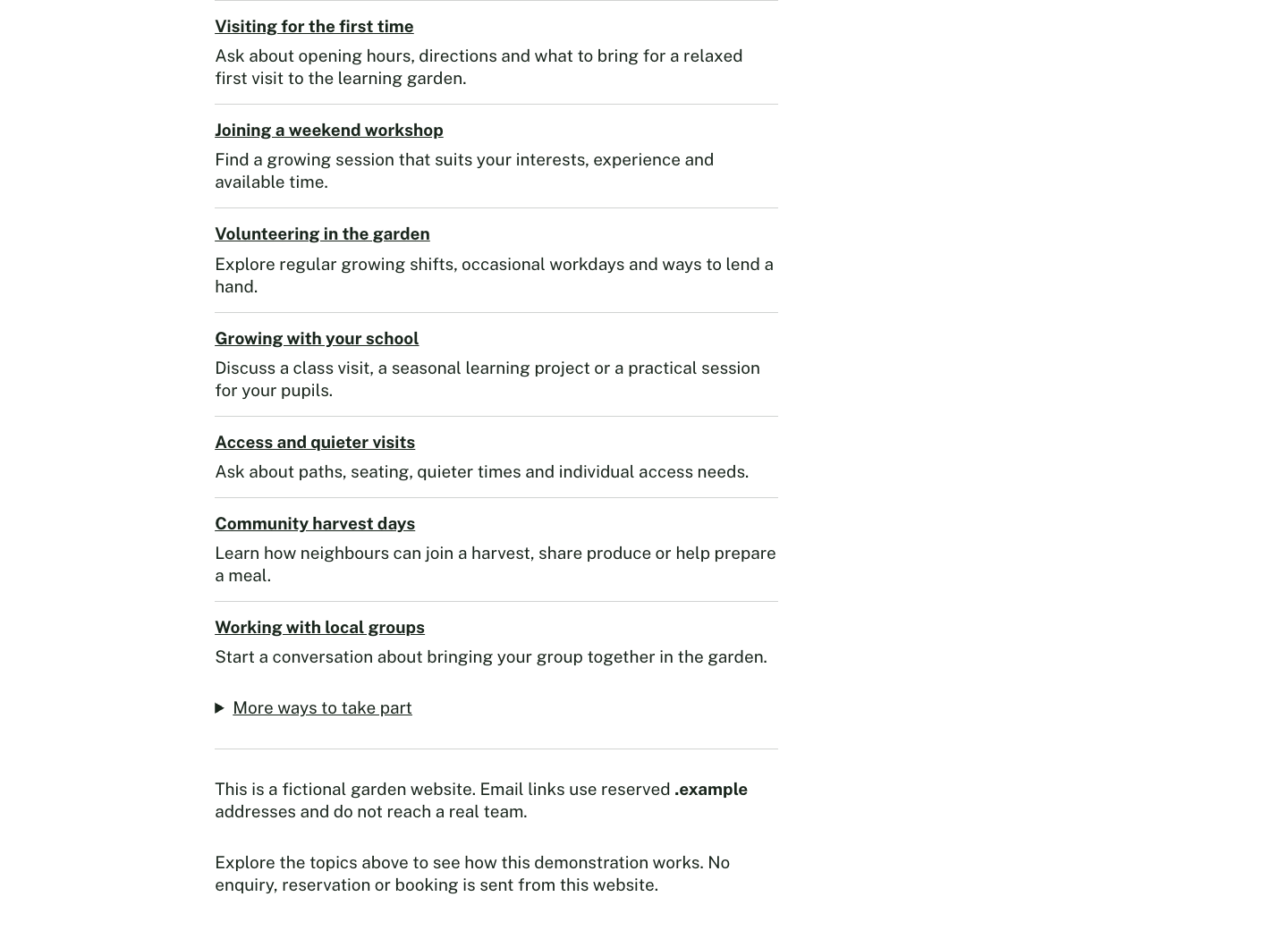
A community garden enquiry directory uses bold linked labels and brief descriptions, with supporting routes under More ways to take part.
01Visitor enquiries

Everyday visitor needs remain visible; supporting ways to participate share one disclosure. The spare right track is one expression, not a requirement.

Context

An enquiry or service directory where visitors must choose among distinct destinations and some genuinely supporting routes can be disclosed on demand.

Forces

  • People describe their needs differently from an organisation's departments.
  • Short labels need enough explanation to distinguish neighbouring routes.
  • Primary routes should be visible, but completeness should not overwhelm scanning.
  • Disclosure saves space at the cost of discovery; essential access, privacy and recovery routes must not become difficult to find.

Present the primary visitor-intent routes as a consistent sequence of linked labels and brief explanations. Keep their visual weight equal unless the content justifies a priority. Place genuinely supporting routes in one clearly named disclosure, preserving the same row anatomy when opened. Keep essential routes visible and the path to the remaining choices explicit.

Known expressions

The resolution is a field, not a frozen form. Start from what the situation asks for.

  1. 01

    A community enquiry directory with everyday visitor needs visible and supporting ways to participate disclosed below.

  2. 02

    A recording-care directory with access and permission routes visible and less frequent collection questions disclosed below.

  3. 03

    Route counts, destination types, column proportions, typography and colour may vary; the stable label-and-description anatomy and primary/supporting boundary remain.

Watch for

  • Hiding essential routes inside the disclosure.
  • A vague More label that gives no clue about the remaining choices.
  • Rows that look like different kinds of action, or descriptions reduced to tiny metadata.
  • Presenting an ordinary FAQ as though it were a routing directory.
  • Letting the hidden choices become another long, unsorted directory.

Evidence

1 reviewed context

An initial reviewed composition and a deliberate recording-care adaptation exercise this resolution. They belong to one working context, not independent recurrence. The Field Note records a useful hypothesis; broader transfer remains to be tested.

Last reviewed:

Independently brief a service directory with different route counts and unequal descriptions. Decide which routes may safely be disclosed, compose without copying this construction, and review narrow-screen readability, keyboard use and the exclusions.